Queens Puzzle Strategy: 5 Techniques to Solve Any Board
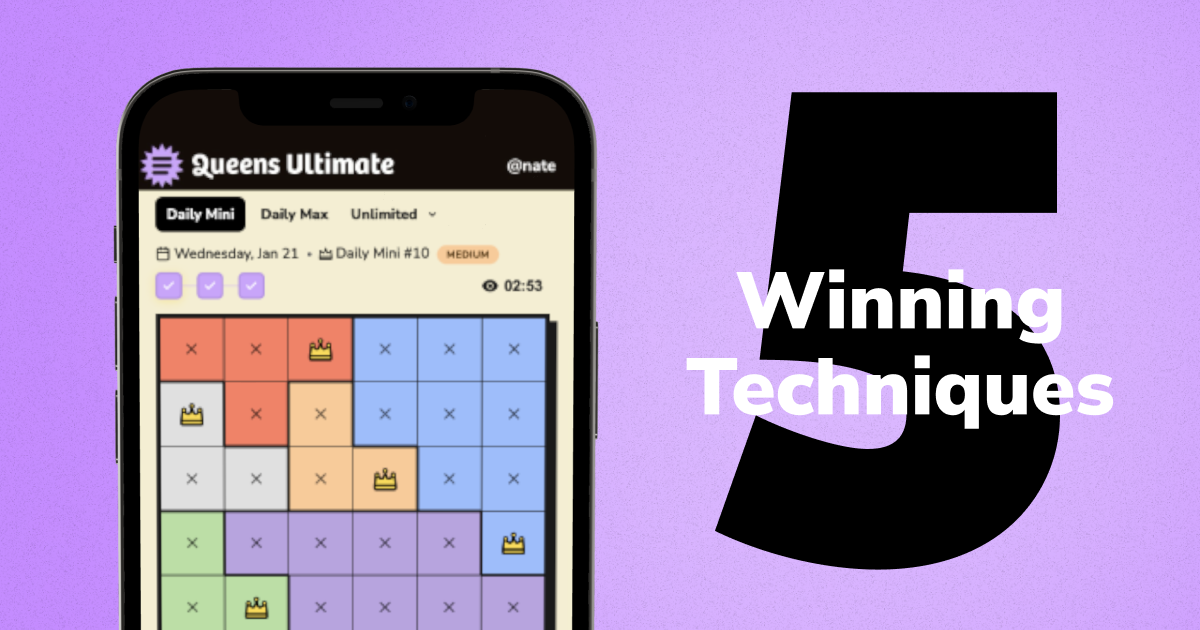
You know the rules. You can solve most puzzles. But some boards leave you staring at the screen, stuck.
The difference between struggling and speed-solving isn't talent — it's technique. Every queens game can be solved using the same five logical patterns, and those patterns work on every grid size from 5x5 up. Learn to spot them, and you'll never guess again.
We're going to show you:
- The 5 techniques that work on any grid
- Visual examples of each one in action
- When to use which technique
- How to chain them together for fast solve times on any logic puzzle grid
These are the same logic patterns our hint system uses internally. Once you learn how to use them, every queens puzzle just clicks!
Quick rules refresher
Before the techniques, a fast reset on the basic rules: place exactly one queen in each row, in each column, and in each colored region. No two queens can share the same row or the same column. No two queens can occupy the same colored region. And no two queens can touch — not horizontally, not vertically, not even diagonally. That's it. Every technique below is just a logical consequence of those four constraints.
The 5 Techniques
Before we dive deep, here's an overview of the techniques you'll learn:
| Technique | What It Does | When to Use |
|---|---|---|
| Forced Placement | Place a queen in any row, column, or region that has only one valid cell remaining | Opening moves and after every placement |
| Region Elimination | Mark every cell in the same row, column, and colored region as a placed queen | Immediately after placing any queen |
| Adjacency Blocking | Eliminate all eight cells surrounding a placed queen, including diagonals | After every placement, paired with region elimination |
| L-Shape Patterns | Eliminate cells diagonally adjacent to the inside corner of an L-shaped region | When a region bends around a corner |
| Row-Column Forcing | Claim a row or column for a region when all its remaining cells share one | Mid-game, especially when stuck |
Master these fundamentals and you'll solve 80% of queens games. Keep in mind, these techniques aren't cheat codes, and their effectiveness is relative to how well you scanned the puzzle and made logical markings/queen placements.
Let's use this sample puzzle as a guide:
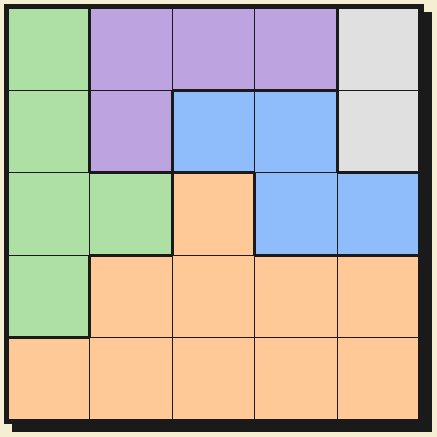
Start with the basics, scan the puzzle and look for regions with single rows/columns and start from there.
And look at that, it seems we already have a good starting point:
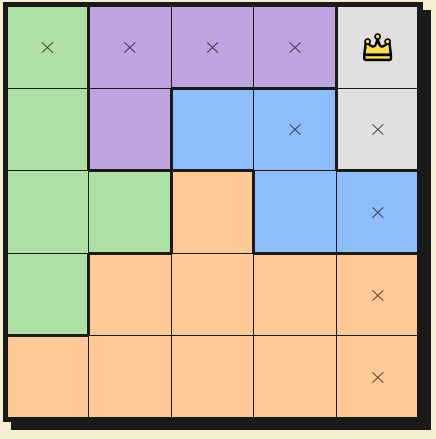
Why that cell in particular of the two possible choices? Well, let's look at what would happen if we chose the other one:
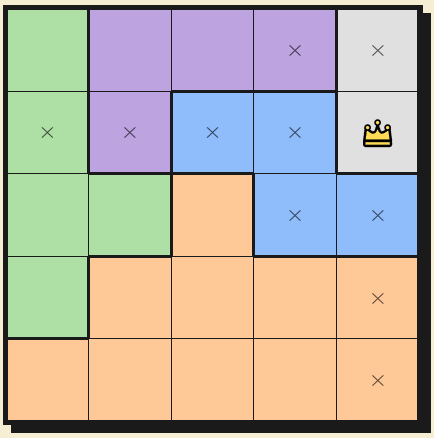
See the difference? The upper-rightmost corner eliminates a lot of cells while opening up possibilities in other rows, columns and regions.
The second choice is not a good one simply because it takes up too many cells and the fact that it immediately blocks out placements in the blue region, automatically resulting in a logic error.
By this opening move alone, the puzzle is already set for solving with the techniques you'll now learn.
Forced Placement
When only one cell is valid in a row, column or region—that's your queen.
This works splendidly on small- to medium-sized grids. Look for:
Single cell in row
Scan each row. If only one cell isn't X-marked, place the queen there.
Single cell in column
Same for columns. One open cell = forced queen.
Single cell in region
If a colored region has only one unmarked cell remaining, that's where the queen goes.
The scanning order:
For speed, develop a habit:
- Check the region you just affected (placing a queen often forces its neighbors)
- Scan rows top-to-bottom
- Scan columns left-to-right
- Check small regions first (fewer cells = more likely to be forced)
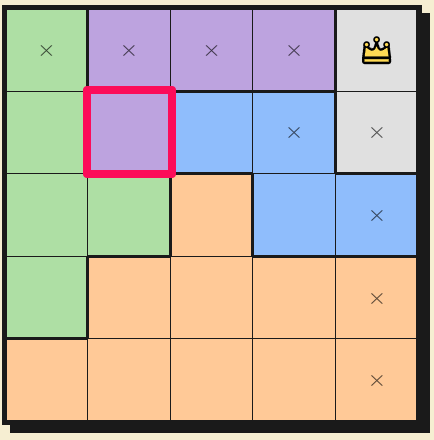
And in our sample puzzle's case, we have just the right cell that fits the criteria:
Chaining placements:
The best solves happen when one forced placement creates another. Place a queen, eliminate, find a forced cell, repeat. When you hit a chain, all the squares and the puzzle collapse in seconds.
When you're stuck:
If no forced placements exist, you haven't eliminated enough. Not to worry, the other incoming techniques will fill in on what you're missing.
Region Elimination
A simple technique. Do this after every queen placement.
When you place one queen anywhere on a filled or empty board, four things become impossible:
- No other queen in that row
- No other queen in that column
- No other queen in that colored region
- No queen in adjacent cells (all surrounding squares)
How to apply:
After placing a queen, immediately mark:
- The entire row (except the queen)
- The entire column (except the queen)
- All remaining cells of that color
- All adjacent cells
Here it is in action with our placements:
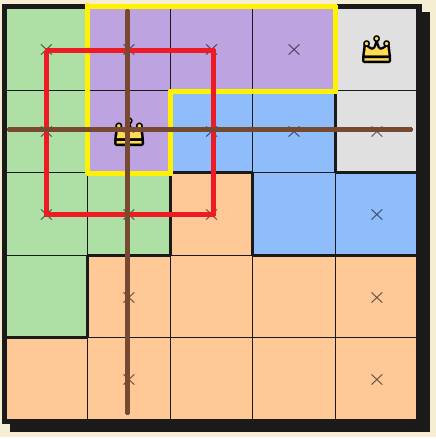
The yellow lines show the color region eliminated.
The brown lines eliminate cells in affected rows and columns.
The red lines show eliminated adjacent cells, including the diagonals.
Why it matters:
This single technique eliminates a large number of cells, even on a 12x12 grid. Do it consistently and the puzzle solves itself.
Common mistake: Forgetting to eliminate the rest of the colored region. Placing a queen DOES create a crosshair-like pattern, but don't forget that the queen "claims" that color—only one queen per region.
Adjacency Blocking
Use the "no touching" rule and use markers to eliminate even more cells.
Queens can't touch—not even diagonally. This means that if two cells of the same color are adjacent, at least one must be empty.
The touching cells rule:
If two cells of the same color are horizontally, vertically or diagonally adjacent:
- One of them is the queen
- The other is eliminated
- All cells adjacent to BOTH are eliminated
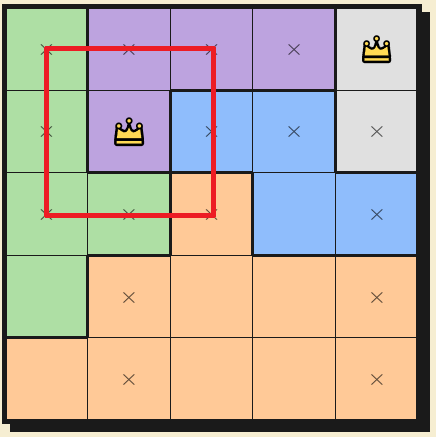
This technique was already shown in our last move:
L-Shape Patterns
When a colored region bends (forms an L), the inside corner eliminates cells in neighboring regions.
How to spot it:
- Find a colored region that turns a corner
- Look at the cells diagonally adjacent to that corner
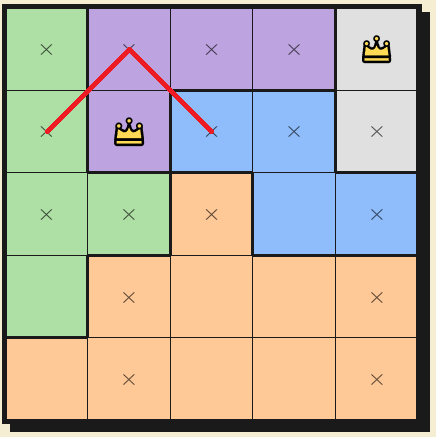
- Those cells cannot contain a queen (they'd touch the corner queen regardless of where it goes in the L)
This technique was also present in our last move:
Row-Column Forcing
When a region can only place its queen in one row or column, eliminate that row/column for other regions.
The pattern:
- Look at a colored region
- Check which columns its cells occupy
- If all remaining cells are in a single column, that region "claims" that column
- No other region can place a queen in that column
Same logic applies to rows.
And this technique was already present on our first move:
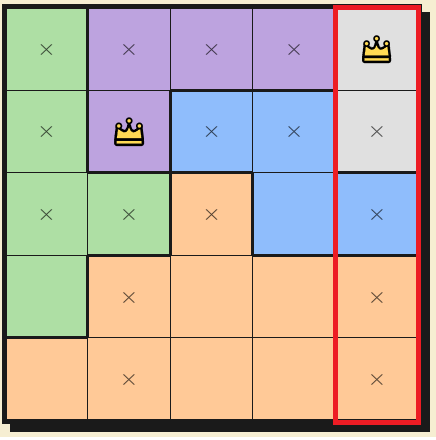
Why this is powerful:
That first placement kickstarted a whole chain of placements with its cell eliminations, and from that point on, the puzzle solves itself.
Rinse and repeat:
At this point, it's simply a matter of rinse and repeat of the same techniques. Every placement of a queen paves the way to another one through elimination. Slice the grid up with markers and logical techniques, and every queens game is yours to dominate!
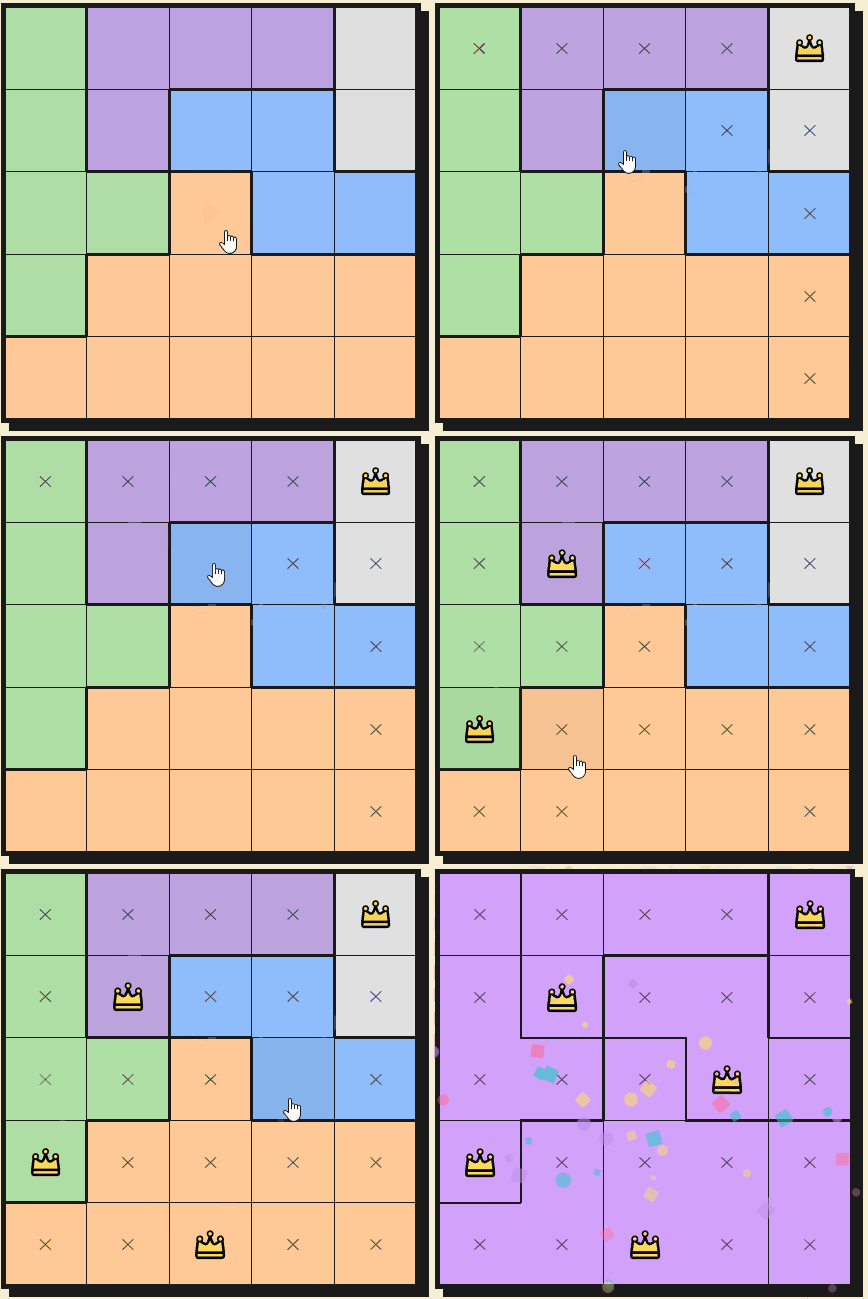
Application of all 5 techniques
To make it easier for you to understand, here's how we solved the sample puzzle:
The Speed-Solving Workflow
Here's how fast solvers chain these techniques:
The opening (First 10 seconds)
- Scan for obvious forces — Any region with only 1-2 cells?
- Look for L-shapes — Apply L-shape pattern technique to all corner regions
- Place any forced queens — Usually 1-2 are immediately visible
The middle game (Next 20-30 seconds)
- Eliminate after each placement — Never skip region elimination
- Check neighbors first — Placed queen often forces adjacent regions
- Use row-column forcing when stuck — Perfect for breaking logjams
The endgame (Final 10-15 seconds)
- Chain reactions — Last 3-4 queens often fall like dominoes
- Trust the process — If you've eliminated correctly, solutions appear instinctively
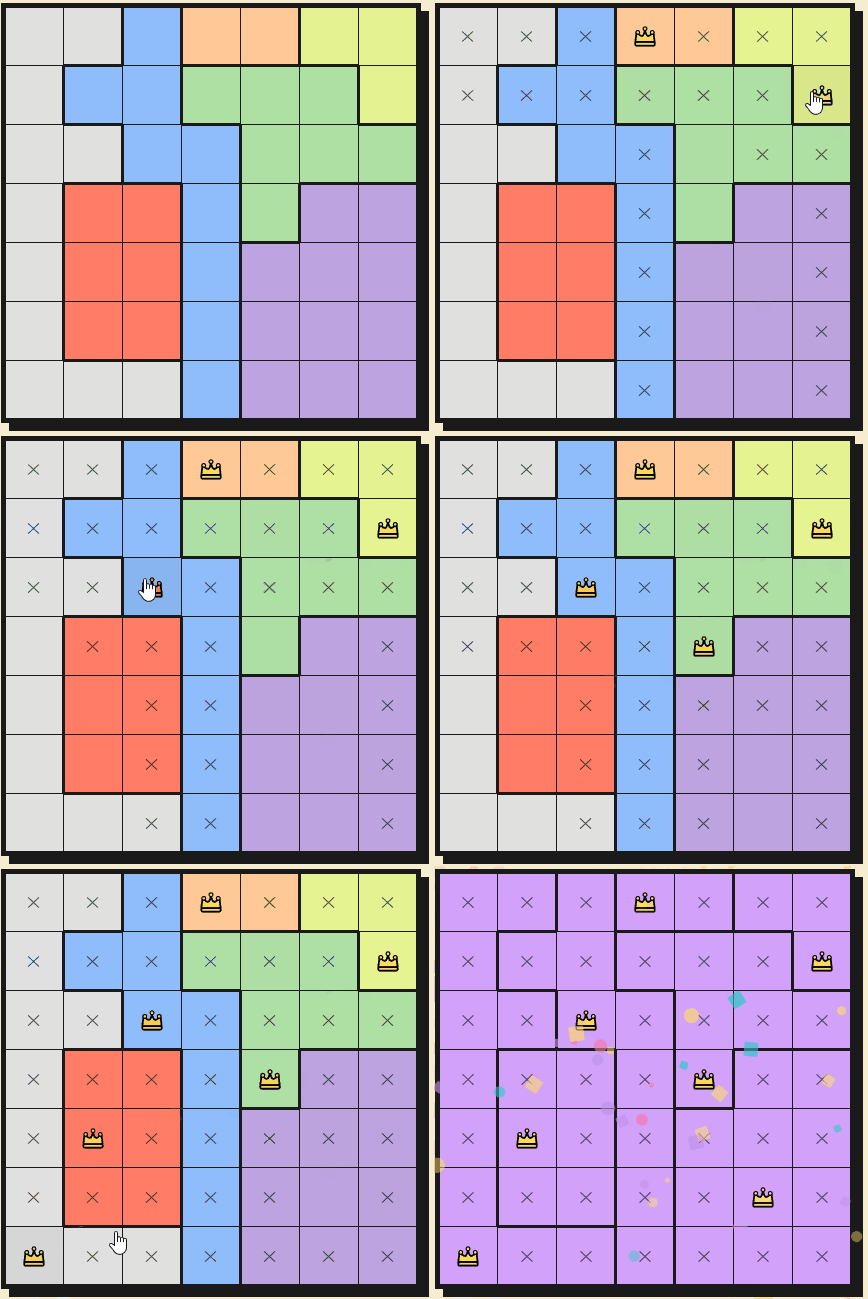
Don't believe us? Here's another queens game with a bigger grid just to show how effective these techniques are:
Target times by grid size:
| Grid Size | Beginner | Intermediate | Fast |
|---|---|---|---|
| 5x5 | 60s | 30s | <15s |
| 6x6 | 90s | 45s | <25s |
| 7x7 | 2 mins | 60s | <35s |
| 8x8 | 3 mins | 90s | <50s |
Practice These Techniques
Reading about techniques doesn't make you faster. Deliberate practice does.
Recommended progression:
- Daily Mini — 3 puzzles, mixed difficulty. Perfect for drilling the basics.
- Unlimited 6x6 — Repeat until you're consistently under 30 seconds.
- Unlimited 8x8 — Where T3-T4 becomes essential. Target a speed of below 60 seconds.
Use the hint system to learn:
When stuck, request a hint. The hint shows which technique applies—study it before continuing. That's how you internalize the patterns. But be careful, over-reliance on hints leads to complacency, and complacency severely affects the drive to learn and improve.
Use the hints as a learning tool, not a crutch.
FAQ
What are the techniques to solve a queens puzzle?
There are five fundamental techniques that solve any queens puzzle: forced placement (find regions with only one valid cell), region elimination (mark cells in the same row, same column, and same colored region after each queen placement), adjacency blocking (eliminate cells touching a placed queen), L-shape patterns (remove cells diagonally adjacent to region corners), and row-column forcing (when a region can only place in one row or column, no other region can use it). Most queens games solve from chaining two or three of these together.
Is Queens Ultimate from LinkedIn?
No. Queens Ultimate is not affiliated with LinkedIn or its games.
What's the fastest way to improve at queens?
Focus on elimination speed. The more unknown variables you get rid of, the faster the answer arrives. Most players guess when they should be eliminating. Use markers religiously—your brain can't track 30+ eliminated cells without them.
Is there only one solution to each puzzle?
Yes. Every queens puzzle has one unique solution. If you're stuck, one of your placements is wrong, or you've missed an elimination.
Why do some queens games feel impossible?
The harder and bigger puzzles require the chaining of techniques. If you're only using T1-T2, harder puzzles will stall. Learn row-column forcing—it unlocks 90% of "impossible" boards.
Not only that, but guesswork leads to wrong placements, and one wrong placement leads to a series of errors.
How do speed-solvers finish in under 30 seconds?
Pattern recognition. They don't calculate—they see L-shapes, single-row regions and forced cells instantly. The top queens game solvers aren't thinking harder — they're just recognizing patterns faster. That only comes from practice and experience, and there is no shortcut to getting good.
Should I use the hint system?
Yes, for learning. Hints show which technique applies to the current board state. Using hints when you're truly stuck doesn't mean you're bad. What's bad is repeatedly guessing without direction and hoping something works.
Treat each hint as a lesson, not a failure.
Play a queens puzzle today and clear all the squares!
We hope that these five techniques were able to help in improving your solving skills. If you're looking for more games like these, check out our website and subscribe to our newsletter!
Practice your newly-learned techniques now →
Play Sudoku, another classic logic game →
Play Sumplete, where logic + arithmetic + grid = best fun →
 Mini Crossword
 Midi Crossword
 Diffle
 Killer Sudoku
 Numberle