N-Queens Puzzle Guide: How Sudoku Players Solve Queens Ultimate
Logic puzzles have a way of rewiring how you think. If you've spent years filling in Sudoku grids during your morning commute or before bed, you've already built a mental toolkit for constraint-based reasoning. The question is: what comes next?
The N-Queens puzzle—a chess-based logic challenge dating to 1848—offers one answer. Queens Ultimate modernizes this classic problem with daily challenges, irregular regions, and mechanics that feel familiar to anyone who's mastered Sudoku's row-column-box constraints.
Queens Ultimate represents a hybrid puzzle that borrows Sudoku's row-and-column logic, layers in the diagonal threats of the classic N-Queens problem, and throws in irregular colored regions for good measure. The transition isn't as jarring as it might seem. If you can solve a 'Hard' Sudoku consistently (or prefer a quicker challenge, try Mini Sudoku), you're already most of the way there.
The N-Queens Puzzle: From Chess Problem to Viral Sensation
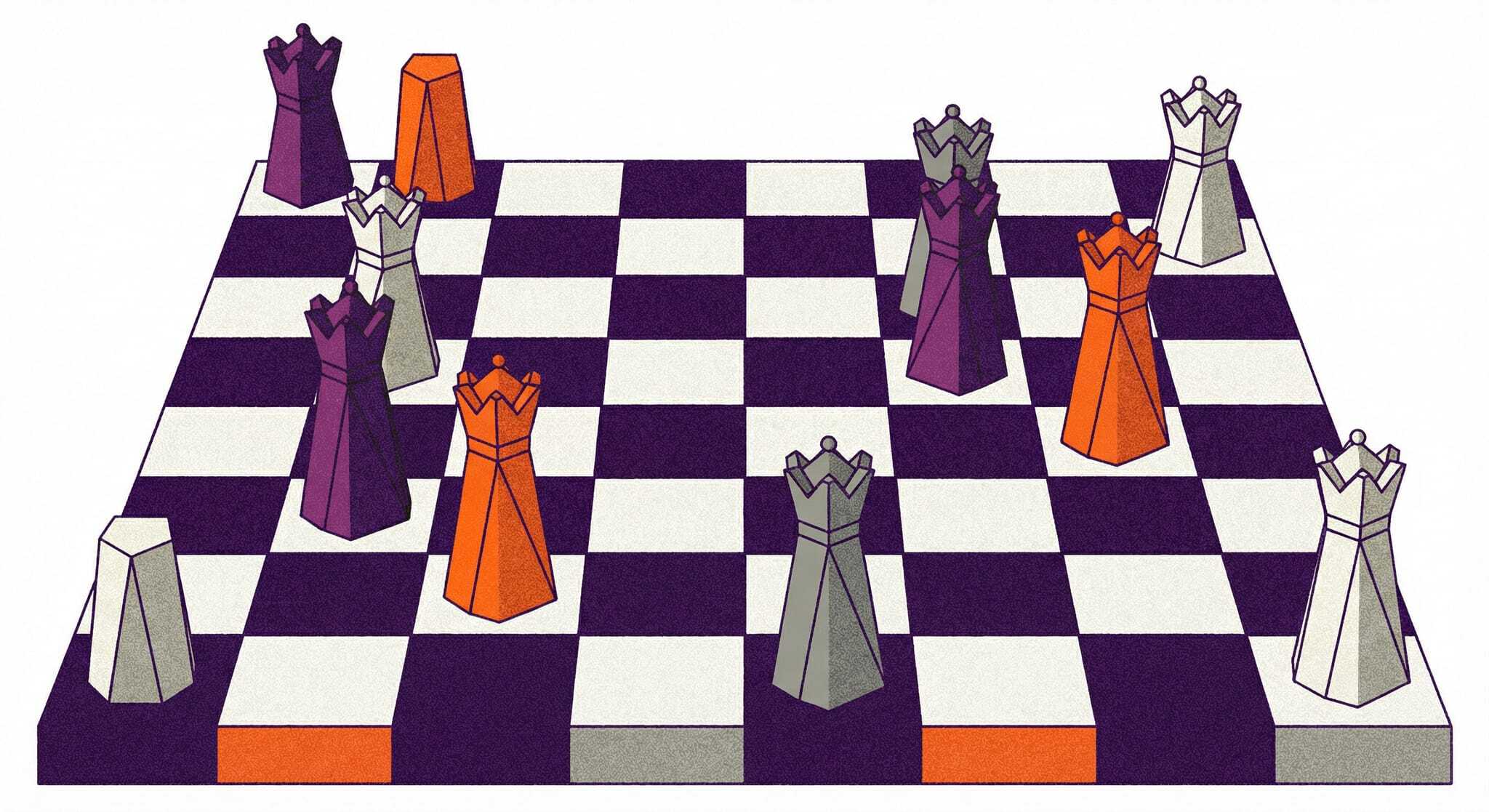
The N-Queens puzzle didn't start with Queens Ultimate—it's a centuries-old logic challenge. Chess composer Max Bezzel first posed it in 1848: place N queens on an N×N chessboard so no two queens threaten each other. Since queens attack along rows, columns, and diagonals, this means no two can share any of those lines.
For over 150 years, the N-Queens problem lived in mathematics and computer science departments. Then it went viral as "LinkedIn Tango," a daily puzzle shared widely across professional networks. The format was perfect for LinkedIn's audience: challenging but solvable, shareable without spoiling solutions, and just complex enough to signal intellectual engagement.
Queens Ultimate is the modern evolution of this classic puzzle. It keeps the core N-Queens mechanics—place one queen per row, per column, per region—but adds irregular colored regions and a stricter "no-touch" rule that eliminates all eight surrounding cells when you place a queen. For Sudoku players, this is familiar territory: you're already fluent in constraint-based reasoning. The transition is about applying that logic to diagonal attack patterns instead of pure number placement.
Key Takeaways
Queens Ultimate combines Sudoku's row-and-column constraints with the diagonal attack mechanics of the N-Queens problem, creating a natural progression for experienced Sudoku solvers.
The "no-touch" rule in Queens Ultimate is stricter than classic N-Queens, eliminating all eight surrounding cells when you place a queen, requiring heightened spatial reasoning.
Your Sudoku experience transfers directly to Queens Ultimate through candidate notation and the "Hidden Single" technique, making the learning curve manageable.
Switching between different logic puzzle types may provide greater cognitive benefits than repeating the same puzzle daily, as diverse challenges build more adaptable neural pathways.
Queens Ultimate's irregular colored regions and visual constraints work spatial reasoning in ways that Sudoku's abstract number-based system doesn't.
The Evolution of Logic Puzzles
Sudoku's dominance in the early 2000s wasn't accidental. The puzzle, originally called "Number Place" when Howard Garns invented it in 1979, hit a sweet spot: simple rules, deep complexity, and no math required despite the numbers. By 2004, Wayne Gould's software had placed it in newspapers worldwide, and suddenly everyone from commuters to retirees was penciling in digits.
But the puzzle landscape has shifted. Browser-based daily challenges now compete for attention, and many introduce mechanics that go beyond pure numerical constraints. The N-Queens problem, first posed by chess composer Max Bezzel in 1848, serves as the mechanical ancestor to many of these newer games. Where Sudoku asks "which number goes here?", Queens-style puzzles ask "where does this piece's influence end?"
Queens Ultimate sits at the intersection of these traditions. It keeps the one-per-row, one-per-column structure you know from Sudoku, adds diagonal attack lines from N-Queens, and introduces irregular colored regions that function like Sudoku's 3×3 boxes—except they're shaped like Tetris pieces.
Sudoku: The Gateway to Deductive Reasoning
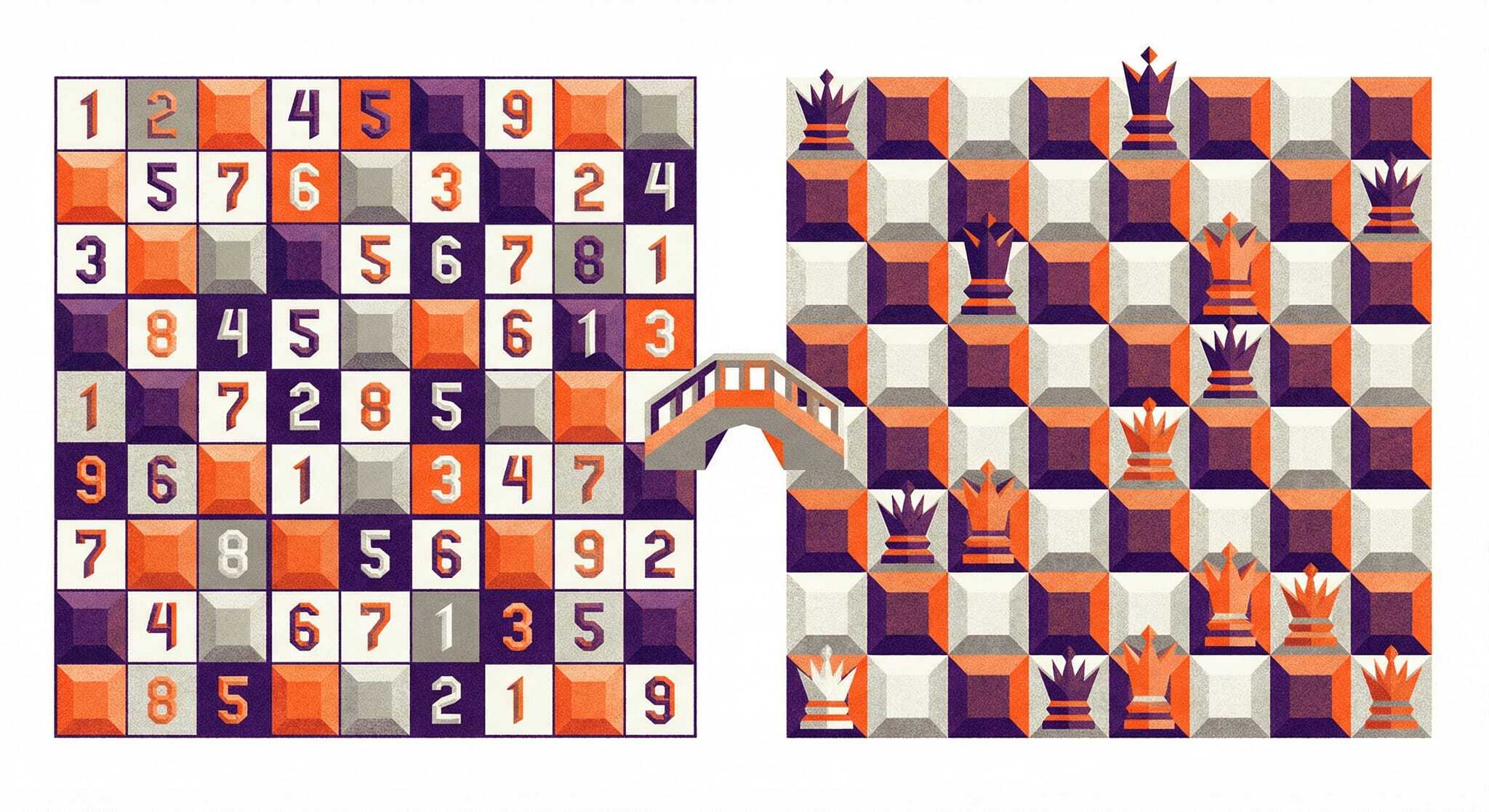
Understanding what makes Sudoku tick helps clarify what you're building on. The puzzle operates through three overlapping constraints: every row must contain digits 1-9 exactly once, every column must do the same, and every 3×3 box follows the same rule. The actual value of each digit doesn't matter—you could replace numbers with colors or symbols and the logic would be identical.
The Mathematics Behind the Grid
The numbers are staggering. There are 6.67 × 10²¹ possible filled Sudoku grids, though only about 5.47 billion are "essentially different" when you account for rotations, reflections, and relabeling. A puzzle needs at least 17 starting clues to guarantee a unique solution. Fewer than that, and multiple valid completions exist.
This 17-clue minimum explains a lot about difficulty scaling. Easy puzzles give you 30+ clues; hard ones hover closer to that minimum, forcing longer chains of deduction before you can place a single digit with certainty.
What Happens in Your Brain
Research using functional near-infrared spectroscopy (fNIRS) shows significant prefrontal cortex activation during Sudoku solving, particularly during deductive phases. A 2019 University of Exeter study found that regular puzzle users had brain functions equivalent to people 8-10 years younger than their actual age, making it ideal for adults who want to keep themselves sharp.
This cognitive benefit extends across puzzle types. Whether you're solving number-based logic puzzles like Kakuro or arithmetic challenges like Mathler, the mental workout follows similar patterns—just with different constraints. With that in mind, check out our list of the best logic puzzles for adults later when you have the time.
Whether puzzles cause cognitive benefits or whether sharper people simply gravitate toward puzzles remains debated. But the correlation is consistent enough that neurologists often recommend them for maintaining mental acuity.
Understanding the Classic N-Queens Problem
Before modern Queens apps existed, the N-Queens problem lived in mathematics and computer science departments. The challenge: place N queens on an N×N chessboard so that no two queens threaten each other. Since queens attack along rows, columns, and diagonals, this means no two can share any of those lines.
The Rules of Engagement
On a standard 8×8 chessboard, there are 92 solutions, but only 12 are considered "fundamental" when you eliminate rotations and reflections. The problem becomes unsolvable for N=2 and N=3—the boards are simply too small to avoid conflicts.
What makes N-Queens different from Sudoku is the nature of the constraints. In Sudoku, a digit in one cell doesn't "attack" anything; it just occupies a slot. In N-Queens, each queen projects influence across the entire board along three axes. Place one queen, and you've eliminated an entire row, an entire column, and two diagonals from consideration.
A Computer Science Benchmark
Edsger Dijkstra used the N-Queens problem in 1972 to demonstrate structured programming techniques. It remains a standard exercise for teaching backtracking algorithms—the systematic trial-and-error approach where you place a queen, check for conflicts, and retreat if you hit a dead end.
The computational challenge scales dramatically. Modern GPU solvers verified all solutions for N=27 in 2025, a process that took roughly 28 days of processing time. The solution count for N=27 exceeds 234 trillion.
Queens Ultimate: The Hybrid Challenge
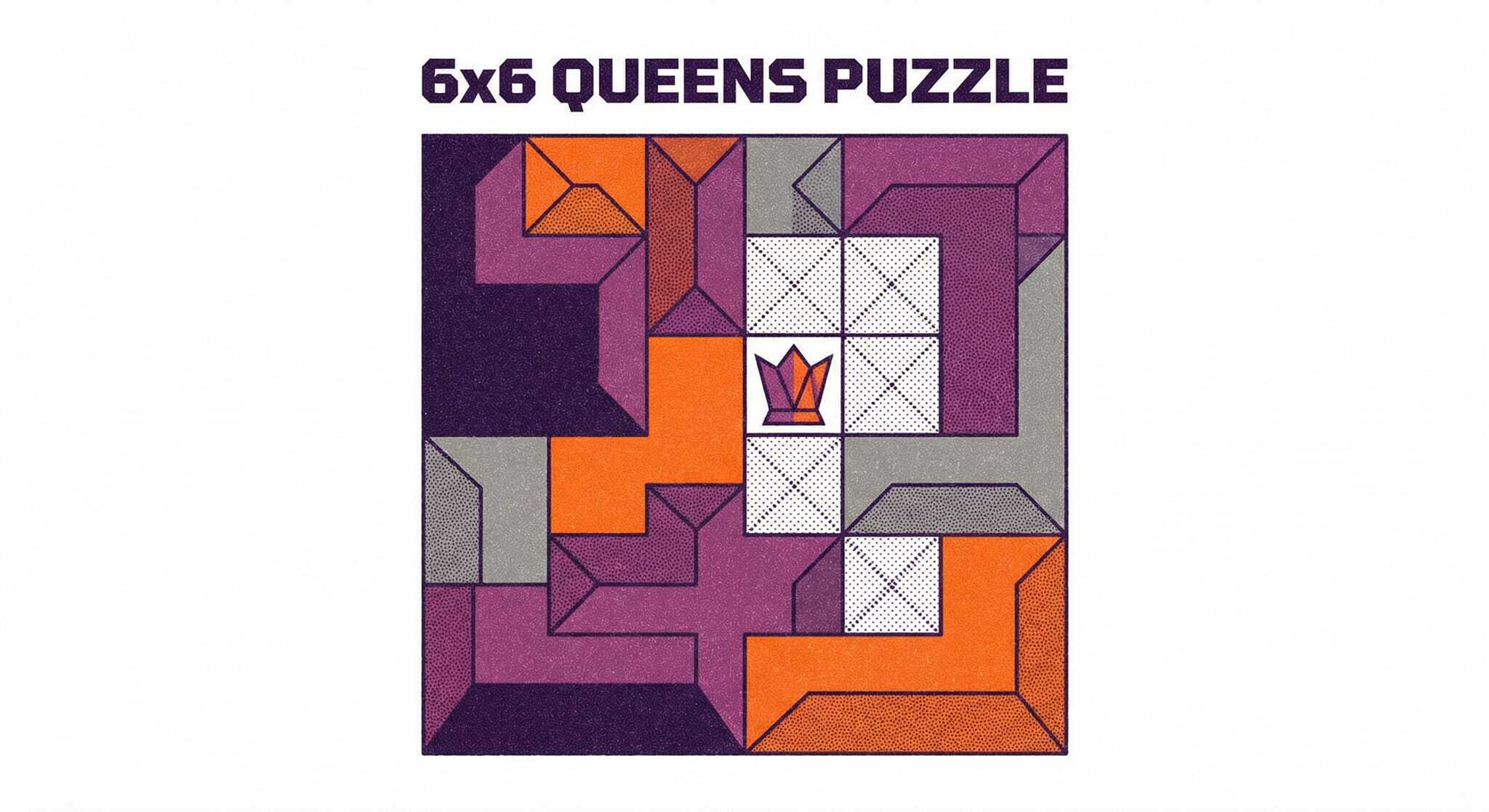
Queens Ultimate takes the core mechanics of both predecessors and adds a twist that changes the solving experience substantially.
New Rules for You
The grid isn't fixed at 9×9. Daily puzzles range from 5×5 on Mondays to 12×12 by Sunday, creating a natural difficulty progression through the week. Instead of uniform 3×3 boxes, you get irregular colored regions—some L-shaped, some snaking across the board, some compact squares.
The placement rules combine familiar elements:
One queen per row (like Sudoku's one digit per row)
One queen per column (same logic)
One queen per colored region (like Sudoku's boxes, but irregular)
No queen can touch another, even diagonally
That last rule is stricter than standard N-Queens. In the classic problem, two queens can sit on adjacent cells as long as they don't share a row, column, or diagonal. In Queens Ultimate, placing a queen eliminates all eight surrounding cells automatically. This "no-touch" constraint adds a layer of spatial reasoning that pure N-Queens doesn't require.
The X Mechanic
If you're an experienced Sudoku player, you already use "candidate notation"—small pencil marks indicating which numbers remain possible in each cell. Queens Ultimate formalizes this with the X mechanic: tap once to mark a cell as eliminated, tap twice to place a queen. The interface auto-marks attacked cells in the same row and column, but you'll need to manually track diagonal and adjacency eliminations.
This notation system is where your Sudoku experience transfers most directly. The mental habit of tracking "what can't go here" before committing to "what must go here" applies identically.
Transitioning Your Skills: A Step-by-Step Guide
The jump from Sudoku to Queens Ultimate is less about learning new logic and more about applying familiar logic to different visual patterns.
Step 1: Transferring the Uniqueness Rule
Start with 5×5 grids in Queens Ultimate's Unlimited mode. At this size, the puzzles are forgiving enough to experiment without frustration.
Apply Sudoku's "Hidden Single" technique: if a row has only one available cell within a specific colored region, the queen must go there. This is identical to spotting that a row has only one cell where a particular digit can fit. The visual presentation differs—you're looking at shapes instead of numbers—but the underlying logic is the same.
Step 2: Mastering the No-Touch Zone
The diagonal adjacency rule trips up Sudoku veterans most often. In Sudoku, cells touching diagonally have no special relationship. In Queens Ultimate, they're mutually exclusive.
Practice helps. Working through N=4 and N=5 Queens problems builds intuition for diagonal threats. The 4×4 board has only 2 solutions; the 5×5 has 10. These are small enough to visualize completely, which trains your eye to see attack lines without conscious calculation.
Step 3: Advanced Elimination Techniques
Once basic placement feels natural, region-based deduction becomes your primary tool.
If a colored region is entirely contained within two rows, those two rows' queens must be inside that region. This eliminates those rows as options for other regions—a powerful constraint that can cascade through the puzzle.
When pure logic stalls, backtracking remains valid. Make a provisional placement, follow the implications, and retreat if you hit a contradiction. You probably do this instinctively in Sudoku; the only adjustment is remembering to check diagonals and adjacencies, along with rows and columns.
Why the Switch Matters for Cognitive Health
Variety in puzzle types may matter more than raw volume. Alternating between Queens Ultimate's spatial reasoning,Sudoku's number placement, and Sumplete's sum-based elimination works different cognitive pathways—potentially building more adaptable neural patterns than solving the same puzzle type daily.
A Scottish study found that lifelong puzzle engagement correlates with a "higher cognitive baseline", but the same study cautioned that puzzles alone don't slow age-related decline. The benefit seems to come from building reserves early, rather than last-minute intervention.
Queens-style puzzles work spatial reasoning and pattern recognition in ways that Sudoku doesn't. Sudoku's constraints are abstract—row 3 and column 7 don't have inherent spatial meaning. Queens Ultimate's constraints are visual: you can see the attack lines, see the region boundaries, see the adjacency zones.
Switching between different logic systems—numbers versus shapes, linear constraints versus spatial ones—may keep your prefrontal cortex more adaptable than repeating the same puzzle type daily. The research here is preliminary, but the intuition makes sense: diverse challenges build diverse neural pathways.
The Future of Logic Puzzles
The puzzle landscape keeps evolving, partly in response to AI capabilities. Large language models can solve 6×6 Sudoku grids at roughly 65% accuracy, but they struggle to explain their reasoning—they pattern-match rather than deduce. This gap has pushed puzzle designers toward formats that reward genuine logical insight over brute-force guessing.
We've expanded into "Sudoku siblings"—games like Sumplete and Mathler that share the daily-challenge format but introduce different mechanics. The newspaper puzzle page has migrated to browsers and apps, with shareable results and streak tracking replacing the solitary pencil-and-paper experience.
For you as a puzzle lover, this proliferation is mostly good news. More formats mean more opportunities to find challenges that fit your particular cognitive style. And the skills transfer: if you've trained your brain on Sudoku's constraint satisfaction, you've built a foundation that applies far beyond any single grid. Whether you're tackling cross-sum puzzles in Kakuro, number elimination in Sumplete, or equation-building in Mathler, you're using the same deductive reasoning muscles—just flexing them in different directions.
 Mini Crossword
 Midi Crossword
 Diffle
 Killer Sudoku
 Numberle