Daily Queens Puzzle: 7 Best Tips & Strategies
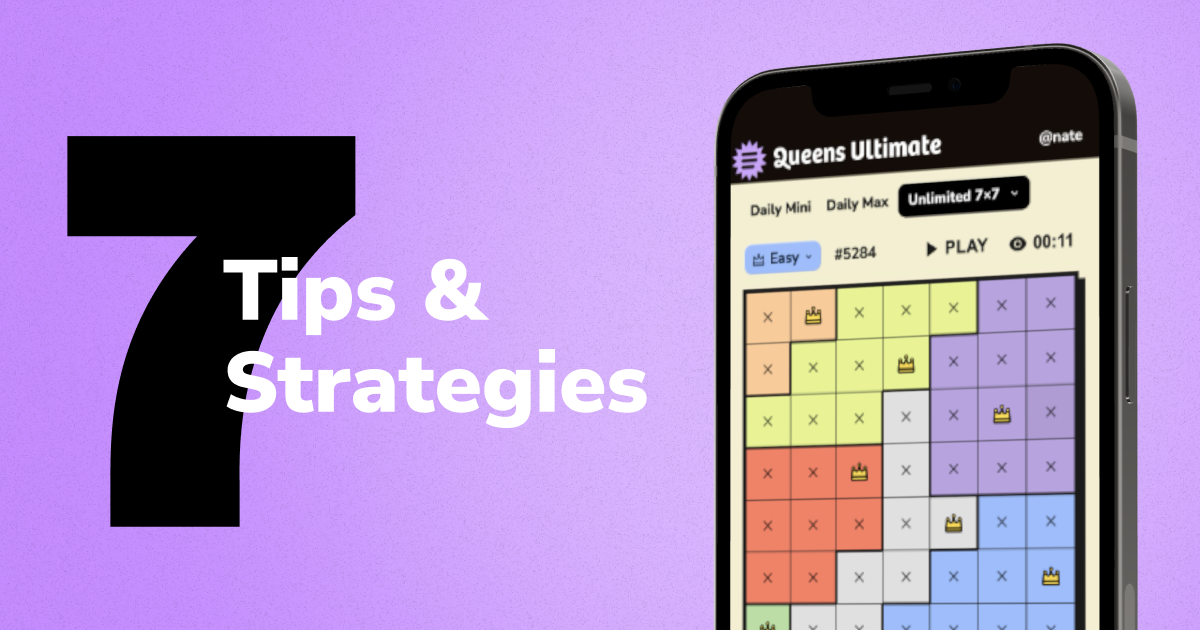
If you're here, you've most likely been hooked by queens puzzle games like LinkedIn Queens* and Queens Ultimate and are in need of good queens puzzle tips. We completely understand how easy it is to fall into the rabbit hole of logic puzzles, so don't worry, we know the exact feeling of wanting to improve your gaming skills!
You already know the rules—exactly one queen per row, column and colored region (with no adjacent queens), though here's a beginner guide for those who need it. But are there any tips or tricks that you should learn to become a better queens puzzler?
Definitely! Here are seven of them to keep in mind!
In this guide:
- Think in Constraints, Not Placements
- Start With Forced Placements & Small Regions
- Row-Column Intersection Scanning & Region Pairing
- Remember the Adjacency Rule
- Breaking Deadlocks on Large Grids
- Speed Tips for Daily Puzzles
- Avoid Common Mistakes
- FAQ
Queens Puzzle Tip 1: Think in Constraints, Not Placements
When you're a beginner, you tend to look where you CAN put queens into. That's alright, because that's technically how it should go, since this is a logic puzzle that is centered on logical placement.
However, the most skilled players don't do that. What they look for is where queens CAN'T go into.
When you think about it, there are more cells where the queens can't go than there are cells to put them in. In every 7x7 grid, there are 49 cells; only 7 of them are valid, and the remaining 42 are eliminated. So the more you slice up the board with markers, the easier it gets.
To become better at queens, don't chase placements—make the right cells come to you via elimination.
Queens Puzzle Tip 2: Place a Queen In Smallest Regions First
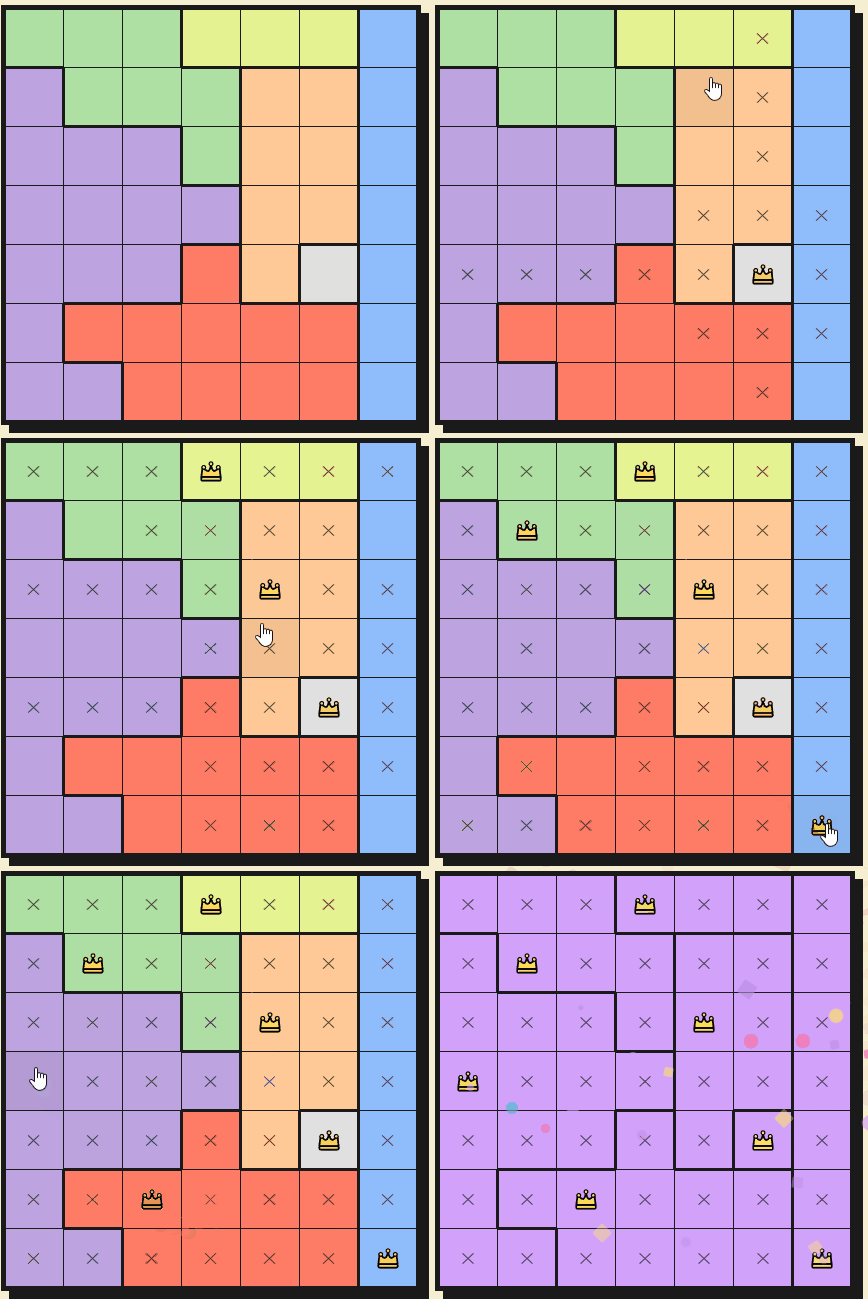
Before you start scanning the whole board, look for singleton regions — colored regions that occupy only one cell. Since every region needs exactly one queen, a singleton is a guaranteed placement. Drop the queen in immediately, then mark out its entire row, column, and all adjacent cells. On many daily puzzles, a single singleton can eliminate 15+ cells in one move and trigger a chain of forced placements across the board.
Even when there's no true singleton, regions with only 2–3 cells behave almost the same way. With so few options, one placement or elimination from a neighboring queen will often reduce them to a single valid cell. That's why starting with the smallest regions is so powerful:
- There's almost no room for error — fewer cells means fewer choices to evaluate
- You immediately remove an entire colored region from consideration
- The row, column, and adjacency eliminations ripple outward, often forcing the next placement automatically
- On larger grids, knocking out small regions early simplifies the board dramatically before you tackle the bigger, more complex shapes
The key mindset shift: don't hunt for where queens can go in the big regions. Instead, clear the small regions first and let the eliminations do the heavy lifting. After placing 2–3 queens in the tightest regions, you'll often find that the remaining regions have only one valid cell left.
Queens Puzzle Tip 3: Row-Column Intersection Scanning
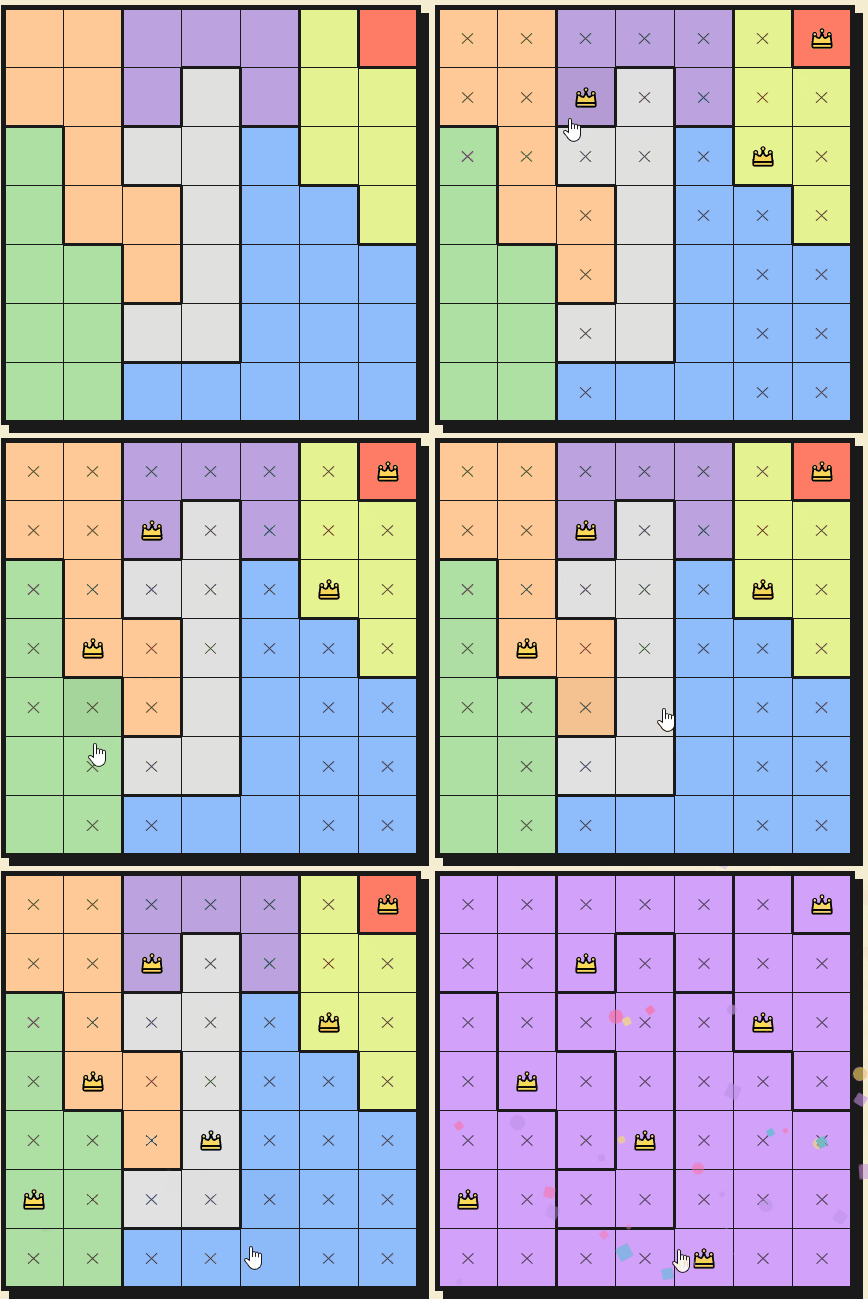
There are times when you do a placement in the smallest region first and it doesn't paint the picture immediately, but that's alright. Even if easy placements didn't come out of it, it still eliminated cells for you.
This is when you start scanning for intersections among rows and columns. Here are what-ifs to think about:
- If a color only appears in one cell of a given row, that's where the queen goes
- If a color spans two cells in one row, but those cells are in the same column as another forced placement, elimination narrows it to one
- If there aren't enough eliminations on your first placement, use markers with the "cross-check" technique. To do this, scan each row left-to-right, then each column top-to-bottom, looking for single-color appearances or similar
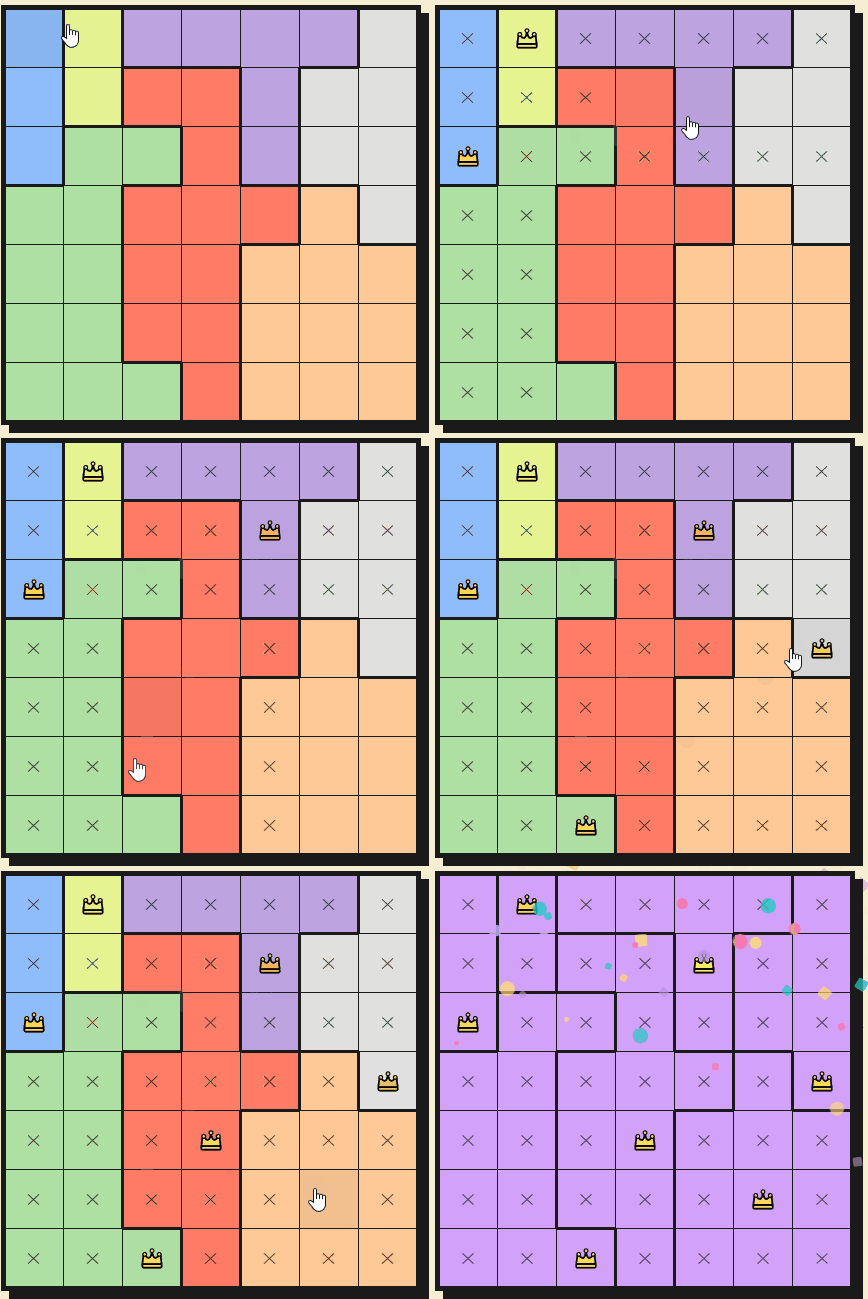
This is especially strong in 7x7+ grids, as larger grids can be brute-forced by heavy scanning and forcing placements to come out.
The Pairing Technique
Once you're comfortable with basic intersection scanning, look for region pairs — two colored regions whose valid cells are restricted to the same two rows or the same two columns. When this happens, those two regions "lock" those rows or columns, meaning no other queen can go there.
Here's how it works: imagine you're solving an 8x8 grid and you notice that the orange region can only place its queen in column 3 or column 6, and the purple region can also only place its queen in column 3 or column 6. You don't know yet which color goes in which column, but it doesn't matter — between the two of them, columns 3 and 6 are taken. That means you can eliminate column 3 and column 6 as options for every other region on the board.
This is powerful because it gives you eliminations without making a single placement. Watch for these patterns:
- Two regions sharing the same two columns — lock those columns out for all other regions
- Two regions sharing the same two rows — lock those rows out for all other regions
- On 9x9+ grids, you can even find triples — three regions restricted to the same three rows or columns, which lock out all three for every other region
The pairing technique is essentially the same logic as "naked pairs" in Sudoku. If you've played Sudoku before, you already know the intuition — and it's one of the most effective ways to break through mid-solve stalls on larger Queens grids.
Queens Puzzle Tip 4: Remember the Adjacency Rule
If eliminating rows and columns isn't enough for you, don't forget that placements essentially clear out a box around the queen.
Combine that with marking out whole rows and columns, and the grid basically solves itself after a few good placements.
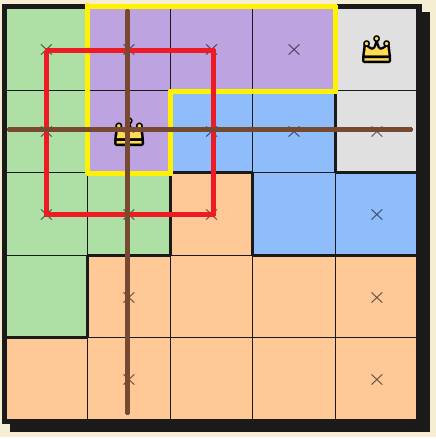
When it comes to placing queens and the adjacency rule, here are things to keep in mind:
- Adjacency eliminations in the center of the board are more powerful than edges, simply because there are more cells in the central areas
- When you place a queen, immediately check if any neighboring region now has only one valid cell left
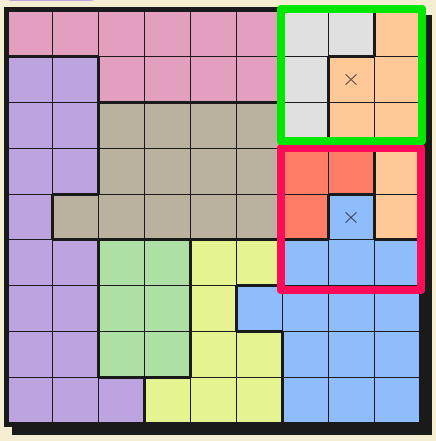
- Adjacency also works for markers, so if a cell is adjacent to a small region that wraps around it, then it's automatically eliminated, like so:
- The "domino effect": a single center placement can force 2–3 subsequent placements on larger grids
Queens Puzzle Tip 5: Breaking Deadlocks on Large Grids
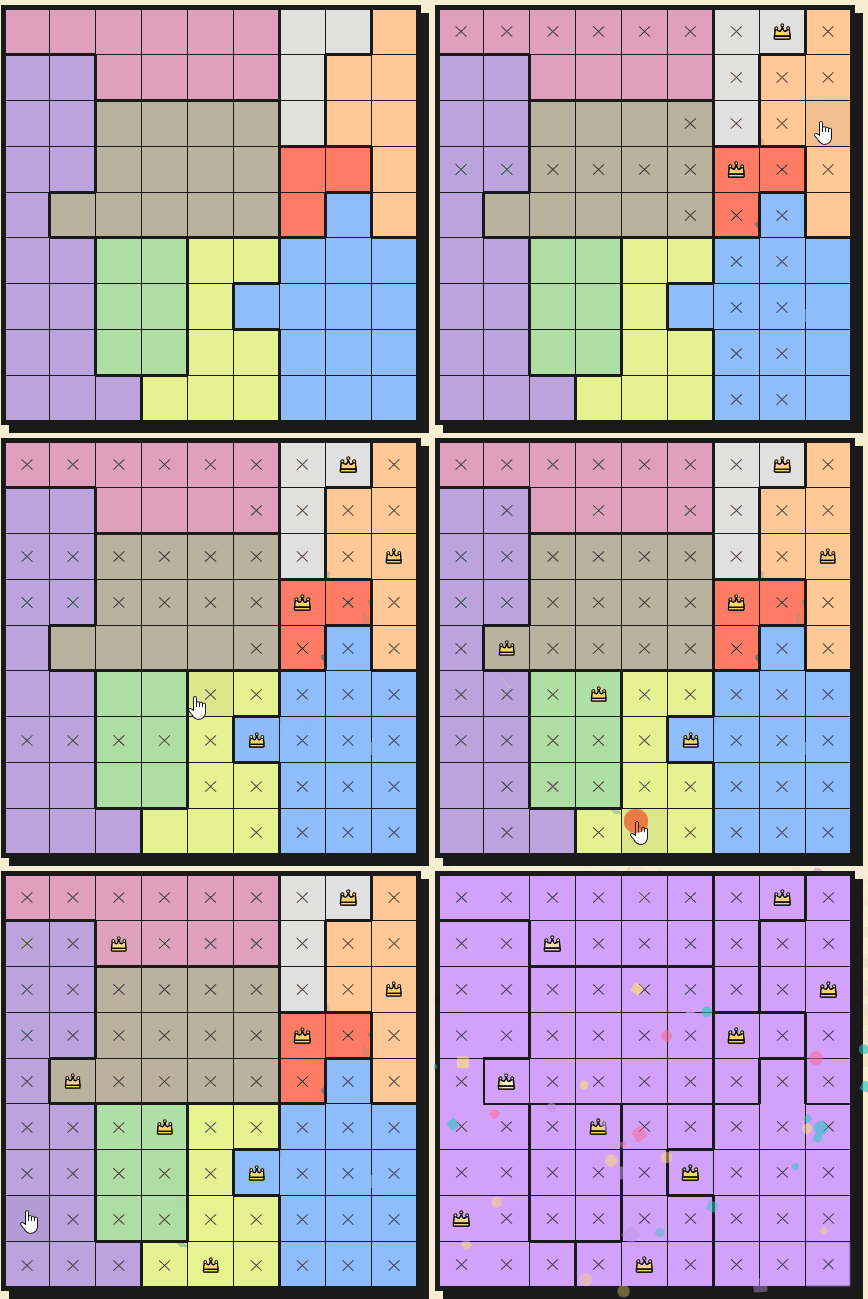
On 9x9+ Expert puzzles, you'll hit points where no obvious move exists. Here are a few tips on breaking through:
- The "what if" technique: temporarily assume a queen goes in cell X, trace the consequences. If it leads to a contradiction, the queen goes to the other options
- When a region has exactly 2 valid cells, and one of them would block another region's only valid cell, you'll know which one is correct by checking adjacency and mentally planning what happens per placement
- When to use markers aggressively vs. when to trust your mental model: On smaller grids, you can hold more in your head, but on 9x9+, it's worth the time to mark everything systematically
- On Hard grids, it's normal to scan the full board 3-4 times before finding the next move
Queens Puzzle Tip 6: Speed Tips for Daily Puzzles
Once you get the hang of solving daily queens puzzles, it's time to start finishing them faster:
- Marker discipline: mark systematically (left-to-right, top-to-bottom) instead of randomly
- Pattern recognition on repeated grid sizes — after 20+ daily puzzles, you'll start recognizing common region shapes
- The Monday-to-Sunday difficulty curve in Queens Ultimate's daily modes and how to adjust your approach
- Use Unlimited mode to practice specific grid sizes you struggle with
Practice with Unlimited Mode now →
Beyond getting faster, building a daily puzzle habit has real cognitive benefits too — research shows that logic puzzles can reduce stress and trigger flow state, making your daily Queens session as good for your brain as it is fun.
Queens Puzzle Tip 7: Avoid Common Mistakes
When you start playing more and more queens puzzles of different grid sizes and difficulties, you have to avoid common mistakes like:
- Tunnel vision on one region while ignoring new information from a recent placement
- Over-relying on markers instead of reasoning through adjacency chains mentally
- Not re-scanning the board after every placement (new eliminations may have opened up forced moves)
- Trying to solve too fast—accuracy beats speed until patterns become second nature
- Forgetting that placing a queen in one colored region eliminates every cell of that color
FAQ
What's the best strategy for any queens game?
Start with the smallest colored region, eliminate cells using row/column/adjacency constraints, and always re-scan the board after every placement. Speed comes from systematic elimination, not guessing.
How do you solve a Queens puzzle fast?
Focus on constraints before placements. Mark eliminated cells systematically, prioritize small regions first and practice the row-column intersection scanning technique on larger grids.
Is Queens the same as Star Battle?
Queens puzzles are closely related to Star Battle, a logic puzzle format created by Hans Eendebak that has appeared in international puzzle competitions since the early 2000s. Both share the same core structure: a grid divided into colored (or outlined) regions, where you place objects so that no two share a row, column, or adjacent cell.
The key difference is quantity. In a standard Queens puzzle, you place one queen per region, row, and column. In Star Battle, the number of stars per region varies by difficulty — 1-star variants play identically to Queens, but 2-star puzzles require placing two stars in every region, row, and column, which significantly changes the solving logic. Some Star Battle competitions even go up to 3 stars per region.
Queens games are also inspired by the N-Queens chess problem, a classic math puzzle that asks how to place N queens on an N×N chessboard so that no two attack each other. The twist in Queens (and Star Battle) is the addition of colored regions as an extra constraint, and the adjacency rule replaces the long-range diagonal attacks that chess queens have — meaning two queens can share a diagonal in Queens, as long as they aren't directly next to each other.
If you enjoy Queens, trying a 2-star Star Battle puzzle is a great next challenge — the extra star per region adds a whole new layer of deductive reasoning.
How hard is the Queens puzzle on Sunday?
Queens Ultimate's daily modes follow an incremental difficulty curve, with Monday being the easiest to Sunday being the hardest. Sunday puzzles feature larger grids and more complex region shapes—solid basics and advanced techniques are key to solving them well.
Can I track my streaks and stats?
Yes, but you'll need to sign up for a free account with us to get those and even more features.
Can I practice Queens outside of the daily puzzle?
Yes. Queens Ultimate's Unlimited Mode lets you choose any grid size (5x5 to 12x12) and has multiple difficulty levels for infinite practice.
Clear all the squares, play Queens Ultimate now!
We hope that we were able to provide you with helpful tips and techniques that will make you a better queens puzzler. If you enjoy playing strategic and structured logic games like these, try out a Wordle-and-crossword hybrid and subscribe to our newsletter!
Play Queens Ultimate Daily Mini now →
Practice with Unlimited Mode now →
*Queens Ultimate is not affiliated with LinkedIn or its games.
 Mini Crossword
 Midi Crossword
 Diffle
 Killer Sudoku
 Numberle