Queens Game: Rules, Strategy, and Where to Play Free
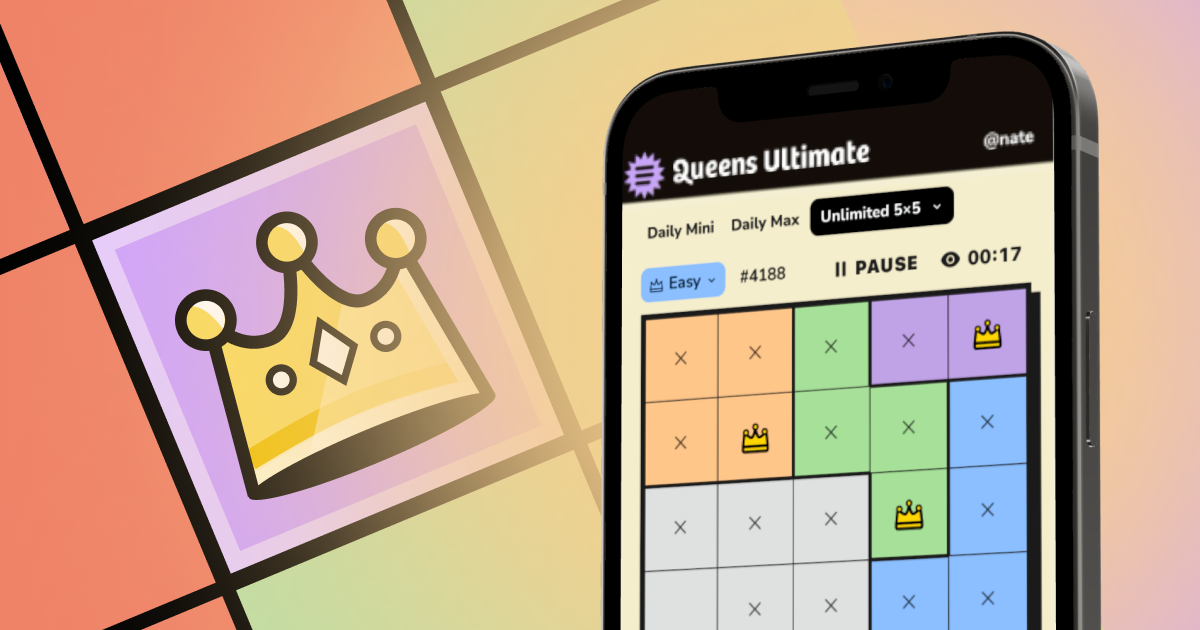
Finished today's LinkedIn Queens and already hungry for more? You're in the right place. Queens is a deceptively simple logic puzzle (place queens on a grid, don't let them touch, satisfy a few constraints) that ends up being one of the more addictive logic puzzles out there. Queens Ultimate gives you unlimited boards, a full archive, and proper difficulty control. No LinkedIn account needed, no paywall, no waiting until tomorrow.
In this post, you'll learn:
- What a queens game is
- How to play it
- How it compares to other puzzles
- Queens Ultimate vs LinkedIn Queens
- Why should you play it
- Where to play it
- FAQs
Below: the rules, the strategy, how it compares to other logic puzzles, and where to play it without hitting a daily limit. Or skip ahead and play queens game online at Queens Ultimate right now.
What Is a Queens Game?
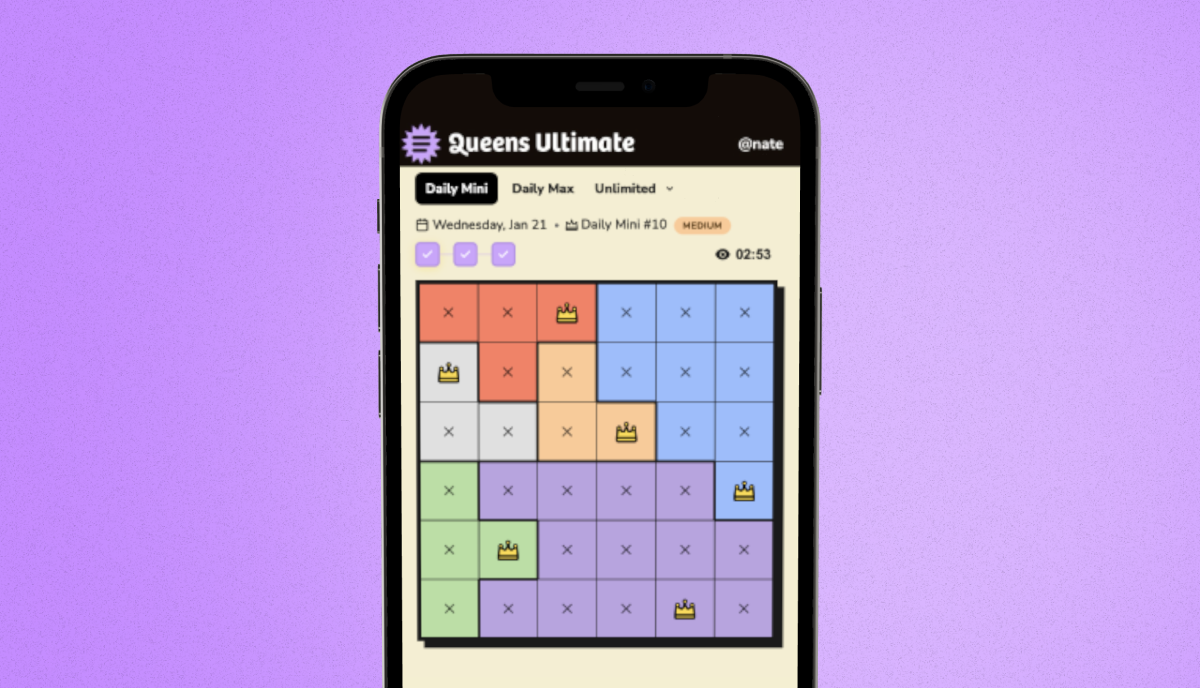
Queens game is a grid-based logic puzzle that asks you to place queens, one per row, one per column, one per colored region, without any two sharing a row, column, region, or diagonal touch. No chess knowledge required. No math. Just spatial reasoning and a willingness to mark the grid as you eliminate possibilities.
Origins and history
- Derived from the n-queens problem, a classic computer science puzzle that asks how many ways you can place N queens on an N×N chessboard so that none attack each other.
- Popularized in puzzle books and indie apps throughout the 2010s.
- Went viral in 2024 when LinkedIn added it to their lineup of new games (alongside Tango, Zip, and Pinpoint).
- Now played by millions of people every day across LinkedIn, Queens Ultimate, and a handful of smaller apps.
What makes queens game different
Most logic puzzles run on numbers (Sudoku), word clues (crosswords), or shaded-cell patterns (Nonograms). Queens runs on pure spatial constraint. You're placing pieces, not filling cells, and the colored regions add a visual layer that makes the board readable at a glance. That's why it works so well as a daily puzzle: a 7×7 solves in 3–5 minutes, the pieces are easy to see on mobile, and there's a genuine "aha" moment when the region chains click into place.
How to Play Queens Game
The rules
- One queen per row. Each row of the grid gets exactly one queen.
- One queen per column. Each column of the grid gets exactly one queen.
- One queen per region. Each colored region gets exactly one queen.
- No queens touching. Two queens can't sit in cells that touch horizontally, vertically, or diagonally. The diagonal rule trips up almost everyone the first few boards.
- One solution. Every well-formed board has exactly one valid solution, which means you can solve it with pure logic, no guessing required.
That's it. Five rules. Every queens puzzle you'll ever play is governed by these.
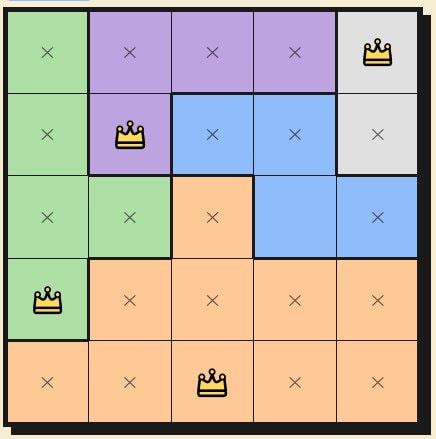
Step-by-step solution guideStart with the most constrained regions. A region with only 2–3 possible cells often has exactly one legal placement once you account for the row, column, and diagonal rules.Mark impossible cells. Use X marks (or Queens Ultimate's auto-mark feature) to eliminate cells before you commit to a queen.Work by elimination, not by placement. Every X you mark narrows the remaining options for other regions. Most boards are solved by elimination before you've placed more than two or three queens.Check the diagonals every single time. The adjacency rule is where almost all mistakes come from.Verify at the end. One queen per row, one per column, one per region, none touching. If all four conditions hold, you're done.
Queens puzzle complete beginner guide →
Common Mistakes to Avoid
- ❌ Forgetting diagonal adjacency (the single most common error)
- ❌ Placing two queens in the same colored region
- ❌ Confusing "one queen per region" with "one queen per row": you need both, simultaneously
- ❌ Guessing instead of eliminating
- ✅ Use pencil marks or the auto-mark feature to track constraints as you go
7 best tips & strats to keep in mind →
Queens Ultimate vs LinkedIn Queens
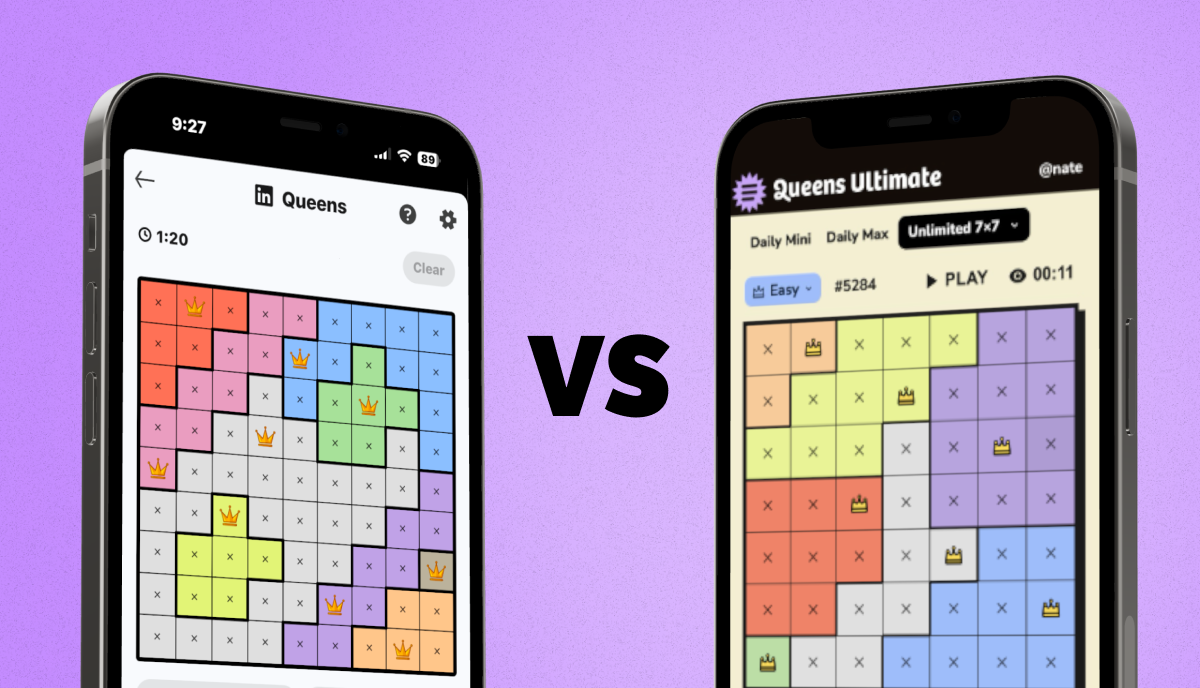
The short answer: Queens Ultimate and LinkedIn Queens are the same queens game played on different platforms. Identical rules — place exactly one queen per row, column, and colored region, with no queens touching horizontally, vertically, or diagonally. What's different is everything around the puzzle: how many you get per day, how much control you have, and whether a LinkedIn account is required to play.
If LinkedIn's lineup of new games is where you got hooked, Queens Ultimate is what you open when the daily board takes thirty seconds and you want another one. Tango, Zip, Pinpoint, and Crossclimb are fun too, but none of LinkedIn's other new games scratch the same itch as one more queens board. For a deeper dive on what Queens Ultimate offers beyond what LinkedIn gives you, see our Queens Unlimited: Beyond LinkedIn guide.
Or jump straight in: Play queens game free now →
Queens Ultimate is not affiliated with LinkedIn or its games.
Queens Game vs Other Logic Puzzles
Queens vs Sudoku
Sudoku is the classic. Queens is the one you finish on the subway. Same family of logic puzzles, very different pacing. Sudoku rewards patience; Queens rewards elimination chains.
If you're coming to Queens from a Sudoku habit, a lot of the same constraint-tracking instincts carry over directly.
We wrote a full guide on that crossover: how Sudoku players solve Queens Ultimate →
Queens vs Nonogram/Picross
Nonograms are another timeless group of puzzles. While it also works off a space-based mechanic, its overall goal is different and can be confusing for newcomers, not to mention that its visuals can be off-putting to the modern player.
Queens is simple, visually appealing, and has gameplay that is generally better for most players.
Queens vs N-Queens Problem
While the n-queens problem isn't technically a game, it still counts as a logic problem. In the aspect of entertainment, the queens puzzle beats its predecessor hands down on visuals alone.
Where to Play Queens Game Online
Queens Ultimate
Queens Ultimate is the unlimited home for Queens online. What you get:
✅ Unlimited play — as many boards as you want, no daily cap
✅ Daily challenges — Daily Mini (3 levels) and Daily Max (10 levels), both reset every midnight
✅ Progressive difficulty — puzzles get harder through the week
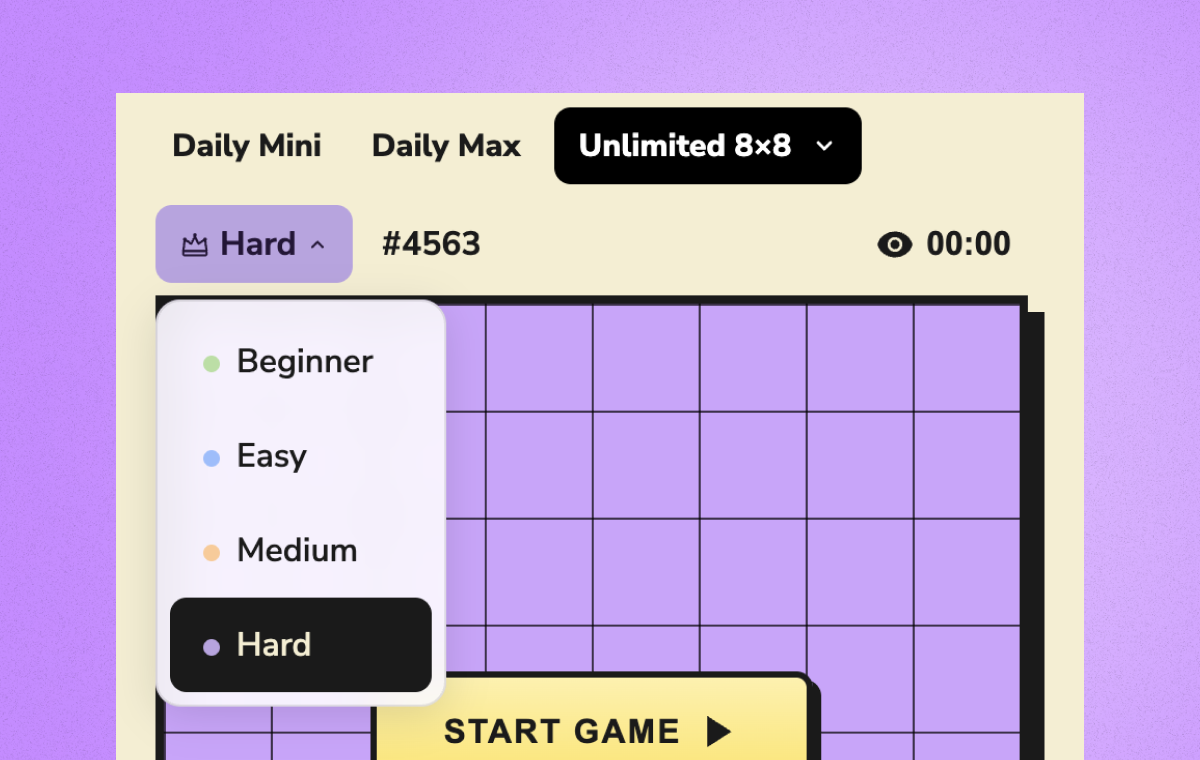
✅ Four difficulty levels — Beginner, Easy, Medium, Hard
✅ Multiple grid sizes — 5×5 through 12×12
✅ No account required — play the moment the page loads
✅ Mobile-optimized — works on any device, minimalist design, no ads
✅ Stats and leaderboards — optional account registration if you want to track streaks
✅ Auto-mark feature — highlights constraint violations automatically ✅ Timer and auto-pause — competitive or casual, your call
✅ Full daily archive — play any past board you missed
Play queens game free at Queens Ultimate →
Other options
- LinkedIn Queens — covered in the comparison above. Good for a one-a-day habit tied to your LinkedIn feed.
- Puzzle Baron — limited free puzzles, older interface.
- Mobile apps — most come with ads or paywalls. Quality varies.
- Puzzle books — static, no auto-mark, no hints.
Queens Game Strategy and Tips

Every board has exactly one solution, which means you never have to guess. As long as you're patient with elimination, logic will get you there.
Beginner tips
- Start with corners and edges. Corners have fewer placement options because of the adjacency rule, so they often force themselves early.
- Look for single-cell regions. A colored region with only one cell is an automatic queen placement, and the easiest win on any board.
- Mark impossible cells aggressively. More X marks = fewer legal placements to evaluate.
- Double-check the diagonals. Every time.
Queens puzzle complete beginner guide →
Intermediate strategy
- Region-on-region analysis. Ask: which regions constrain which? A tall narrow region often forces placements in neighboring regions.
- Chain logic. "If a queen goes here, then these cells are blocked, which means this region has only one option." The longer your chains, the harder the board you can solve without guessing.
- Pattern recognition. After a few dozen boards you'll start recognizing configurations. Pairs of regions that interlock, L-shaped regions in corners, and so on.
- Work backwards. Sometimes the fastest solve is eliminating everywhere a queen can't go before placing any at all.
7 queens game tips and strategies →
Advanced techniques
- Constraint propagation. Run multiple elimination passes in sequence. Each pass reveals new constraints, which enable the next pass.
- Singleton blocks. A region that can only contain a queen in one cell. Always place it first.
- Pairing technique. Two regions that share the same two candidate cells: the queens for those regions must go in those two cells, which eliminates those cells for every other region.
- Systematic approach for 10×10+. Bigger grids need discipline. Mark impossible cells first, identify forced placements, then place queens. Don't place a queen until you've exhausted elimination.
Why Play Queens Game Daily?
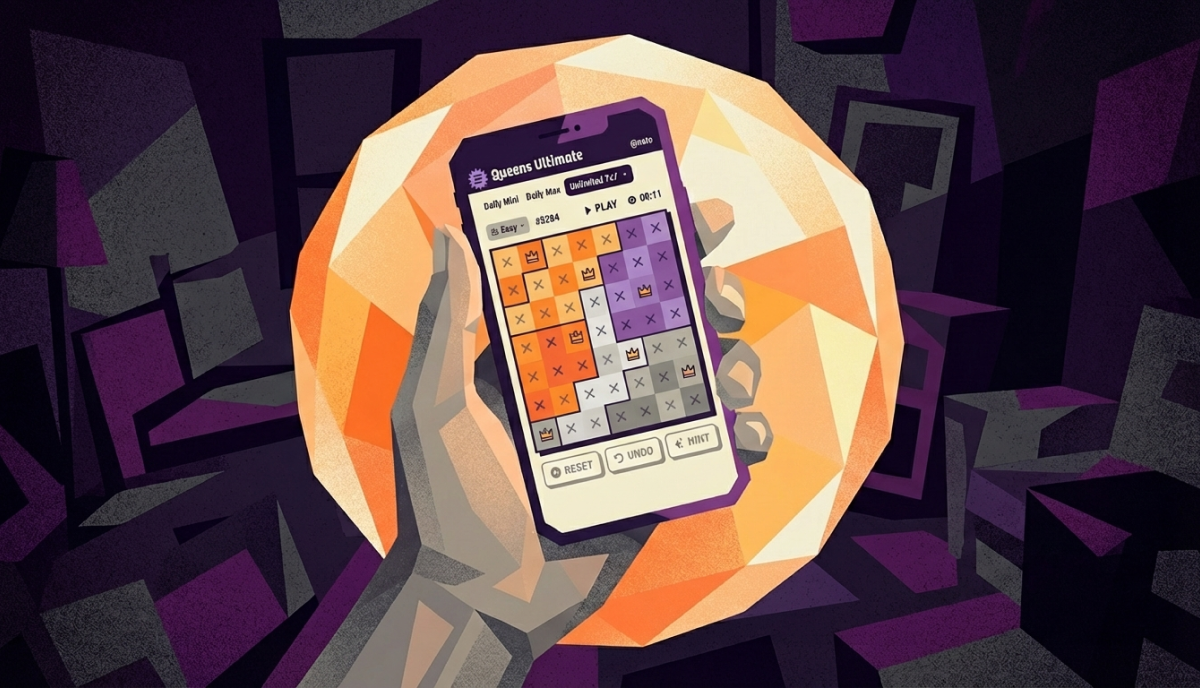
Brain training
- Spatial reasoning. Visualizing queen placements strengthens the same circuits you use for maps and diagrams.
- Logical deduction. A daily workout in "if this, then that" chains.
- Pattern recognition. Solve faster with practice. The same shapes keep showing up across logic puzzles.
- Focus and concentration. Short enough to hold your attention, long enough to train it.
Stress relief
A 2–5 minute puzzle is the perfect mental reset. No scoreboard pressure, no loss condition, just a clean logical problem with a guaranteed solution at the end. Logic puzzles and stress management is a real documented combo.
Habit building
- Progressive daily difficulty keeps you coming back.
- Streak tracking gives you a reason to play every morning.
- Leaderboards (optional) add a competitive layer.
- Fits into a morning routine alongside coffee and email.
Accessibility
- No chess knowledge required.
- No math required.
- Language-independent — the rules are visual.
- All ages — 8+ is the usual starting point.
- High-contrast mode available for colorblind account holders.
Register for a free HGG account →
Queens Game Difficulty Levels
Grid sizes explained
5×5 (Beginner)
- 5 queens to place
- 1–2 minutes
- Perfect for learning the rules
- Low frustration, high reward
7×7 (Intermediate)
- 7 queens to place
- 3–5 minutes
- The sweet spot for daily play. Long enough to feel satisfying, short enough to fit into a coffee break
9×9 (Advanced)
- 9 queens to place
- 5–10 minutes
- Requires a systematic approach
- Satisfying solve, especially on Hard
10×10 and up (Expert)
- 10–12 queens
- 10–20 minutes
- For serious puzzlers and star battle puzzles veterans
- Deep logical chains, constraint propagation required
Star Battle vs Queens comparison →
Queens Game on Mobile vs Desktop
Mobile advantages
✅ Play anywhere — commutes, waiting rooms, the couch
✅ Tap-to-place touch controls
✅ Perfect for short sessions
✅ Easy one-handed play
Desktop advantages
✅ Larger grid visibility for 10×10+ puzzles
✅ Keyboard shortcuts available
✅ Easier to scan the whole board at once
✅ Multiple windows if you want to compare strategies
Both work well. Mobile is where most people play Queens Ultimate day-to-day; desktop is where Expert-difficulty 12×12 boards make the most sense.
Queens Game FAQ
Is queens game the same as the N-Queens problem?
Queens game is the playable, gamified version of the classic n-queens problem from computer science. The n-queens problem asks how many ways you can place N non-attacking queens on an N×N chessboard. Queens gives you a specific board (one puzzle, one solution) and adds the colored-region constraint so every board has exactly one valid placement.
Do I need to know chess to play queens game?
No. Queens is pure visual logic. The "queen" is just the name of the piece. None of its chess movement rules apply. If you've never played chess in your life, you can solve these puzzles fine.
Is there only one unique solution per board?
Every Queens Ultimate board has exactly one unique solution. The colored-region rule is what guarantees uniqueness. Without it, you'd have the classical n-queens problem, which has many valid solutions at most grid sizes.
How long does a queens game puzzle take to solve?
- 5×5: 1–2 minutes
- 7×7: 3–5 minutes
- 9×9: 5–10 minutes
- 12×12: 10–20 minutes
Speed improves fast with practice. Most players cut their times in half within the first week.
Can I play queens game free without a LinkedIn account?
Yes. Queens Ultimate is queens game free, unlimited, and requires no LinkedIn account or sign-up of any kind. You can play instantly at queensultimate.com. LinkedIn Queens requires a LinkedIn account; Queens Ultimate does not.
What's the difference between Queens Ultimate and LinkedIn Queens?
Same puzzle, different platforms. Both follow the exact same rules: one queen per row, column, and region, with no adjacency allowed. Queens Ultimate gives you unlimited boards, adjustable grid sizes (5×5 to 12×12), four difficulty levels, and no account requirement. LinkedIn Queens gives you one board per day tied to your LinkedIn account. See the full comparison above.
Can queens touch each other?
No. Queens touching in any direction (horizontally, vertically, or diagonally) is not allowed. Two queens in cells that share an edge or corner is an invalid placement. The diagonal rule is what makes the game harder than it first looks.
Is there a new board every day?
Yes. Queens Ultimate posts new Daily Mini and Daily Max puzzles every midnight. Daily Mini is three quick levels; Daily Max is ten levels of progressive difficulty. Unlimited mode also lets you generate a brand-new board anytime with no waiting. If LinkedIn keeps adding new games to its lineup but you want more Queens specifically, this is where to find them.
Can I play queens game offline?
Queens Ultimate needs an internet connection to load puzzles. Once a board is loaded, you can complete it offline. Full offline play isn't currently supported.
Is there an archive of past puzzles?
Yes. Queens Ultimate has a full daily archive. You can play any past Daily Mini or Daily Max you missed.
What's the difference between Daily Mini and Daily Max?
- Daily Mini: 3 levels per day, quick play
- Daily Max: 10 levels per day, extended challenge
Both reset at midnight, both track streaks independently.
Is queens game good for kids?
Yes. Queens is well-suited for ages 8+ (spatial reasoning develops strongly in this window). Start with 5×5 Beginner boards and move up as they get the hang of the adjacency rule.
Start Playing Queens Game Now
Queens is one of the best logic puzzles you can add to your morning routine. Quick enough to finish with coffee, logical enough to keep your brain awake, and genuinely satisfying when the last queen clicks into place. Queens Ultimate gives you the unlimited version: play as many boards as you want, pick your grid size and difficulty, and never hit a one-a-day wall.
If you like Queens, you'll probably also enjoy Hitori Conquest and Sudoku Conquest, both constraint-satisfaction logic puzzles from the same family. And if word puzzles are more your speed, Crosswordle is the daily our Queens players tend to add to their routine.
Subscribe to the Hey Good Game newsletter for announcements about new games and puzzle launches.
Queens Ultimate is not affiliated with LinkedIn or its games.
 Mini Crossword
 Midi Crossword
 Diffle
 Killer Sudoku
 Numberle